
by Gertrud U. Rey
Across Asia and beyond, rice crops are frequently attacked by planthoppers and leafhoppers – insects that damage plants during feeding and transmit viruses that can wipe out entire harvests. The chemical insecticides typically used by rice farmers can pose environmental and health risks, and they often also become less effective over time. New strategies for controlling virus-carrying insects are urgently needed.
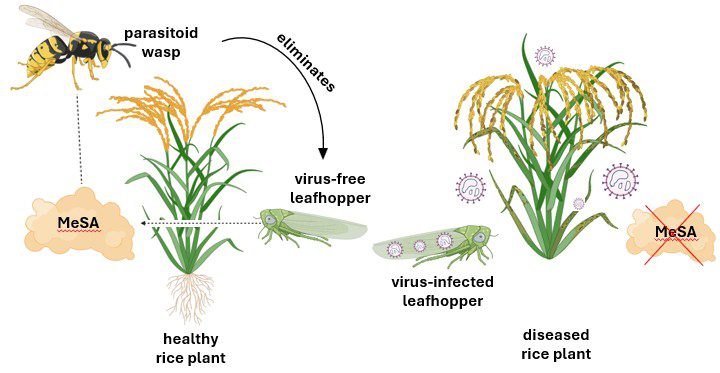
Plants have developed sophisticated defenses against both insect pests and the viruses those pests transmit. These defenses include direct strategies, such as physical barriers like fine hairs or sticky resins that make feeding more difficult, and indirect strategies that rely on chemical signals to recruit natural predators of the insects. One of the most important of these signals is methyl salicylate (MeSA), a volatile compound released by rice plants to attract parasitoid wasps. The wasps lay their eggs inside the eggs of planthopper/leafhopper insects, destroying them before they can hatch, and thereby keeping pest populations in check (see left side of image).
A new study published in Science Advances reveals how some viruses that infect rice plants have evolved strategies that undermine the plant’s indirect defenses and ensure the viruses’ own viability and transmission. The researchers show that rice stripe virus (RSV) suppresses the host plant’s ability to produce MeSA by disabling the signaling pathway required for its synthesis. By silencing this chemical distress signal, RSV prevents parasitoid wasps from being attracted to the plant, allowing the planthopper/leafhopper insects to feed more freely and spread the virus more effectively. In short, the virus-induced loss of MeSA results in fewer parasitoid wasps, higher numbers of virus-carrying insects, and increased viral transmission (see right side of image).
The authors also uncovered the molecular mechanism by which the virus suppresses MeSA production. RSV appears to interfere with the expression of OsBSMT1, the gene encoding the enzyme that generates MeSA by adding methyl groups to salicylic acid, the MeSA precursor. When this regulatory pathway is disrupted, MeSA levels decline sharply. This suppression of MeSA decreases wasp recruitment and provides an advantage to the pest insects because their wasp predators are reduced in number. This is a consistent outcome that is caused by multiple rice viruses that are transmitted by multiple insect species. The researchers further observed that OsBSMT1 expression increased when rice plants were infested with virus-free leafhoppers, but decreased when the plants were infested with virus-carrying leafhoppers. This gene therefore represents the key enzymatic step controlling MeSA biosynthesis in the plant’s defense system.
By deploying slow-release spheres that emitted MeSA into rice fields, the researchers were able to counteract the effects of RSV infection. MeSA increased the abundance of parasitoid wasps and reduced populations of planthoppers and leafhoppers in MeSA-treated fields compared to untreated control fields. These findings suggest that MeSA could serve as a promising, eco-friendly tool for integrated management of both pests and the viruses they transmit.
This work highlights an ongoing evolutionary arms race unfolding within our agricultural systems. By clarifying the biological processes through which viruses alter plant signaling pathways in ways that increase virus transmission, scientists can develop more effective and sustainable crop protection strategies. MeSA-based interventions, for instance, could reduce dependence on chemical pesticides and help reestablish ecological balance.
[This article was discussed in detail on TWiV 1293.]
Flu vaccines didn’t work that well in the US, officials find